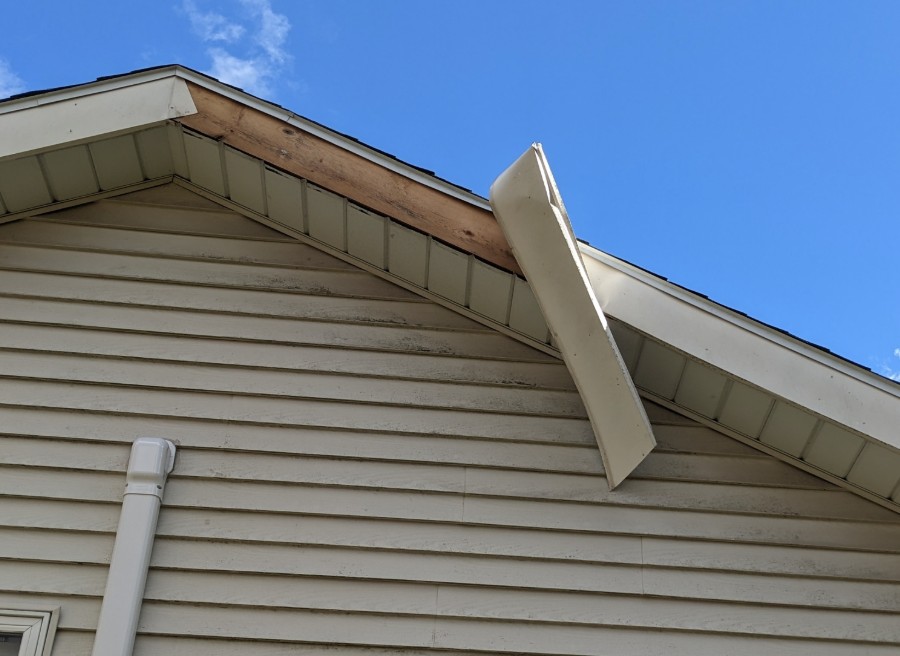
Length of cream fascia metal peeled loose and hanging from a gable rake, exposing bare wood behind it, on a home in Dayton, Ohio

Dayton Exterior Services

Soffit & Fascia Repair in Dayton, Ohio

Soffit and fascia aren't trim. One carries your gutters, the other ventilates your attic — and when they fail, the damage shows up somewhere else.

  • Serving Dayton since 2012
  • Fully insured
  • AlphaOne Advantage Warranty
  • Free roofline assessment
2012
Serving Dayton since
150+
Five-star Google reviews
4
Roofline components we check
FREE
Assessment, no obligation

Roofline

Soffit and fascia repair in Dayton

Most people meet their soffit and fascia when something else goes wrong. Gutters that keep pulling loose. A wasp nest in the eave. Ice dams every February. Paint that won't stay on one board.

All four are roofline problems wearing a different costume, and none of them get fixed by treating the symptom.

We repair and replace soffit and fascia throughout Dayton, Kettering, Centerville and Beavercreek.

It sits alongside gutter repair, gutter replacement, roof repair and storm damage restoration — and the assessment covers all of it, because the roofline rarely fails in one place only.

  • 01 Rotted fascia board replacement
  • 02 Fascia metal repair and recapping
  • 03 Soffit panel repair and replacement
  • 04 Restoring blocked soffit venting
  • 05 Drip edge and flashing repair
  • 06 Pest exclusion at the eave
  • 07 Rafter tail repair
  • 08 Full roofline replacement

Diagnostics

What we find at the roofline

Three of the things we see most often on a roofline assessment, and what each one is telling us about the eave behind it.

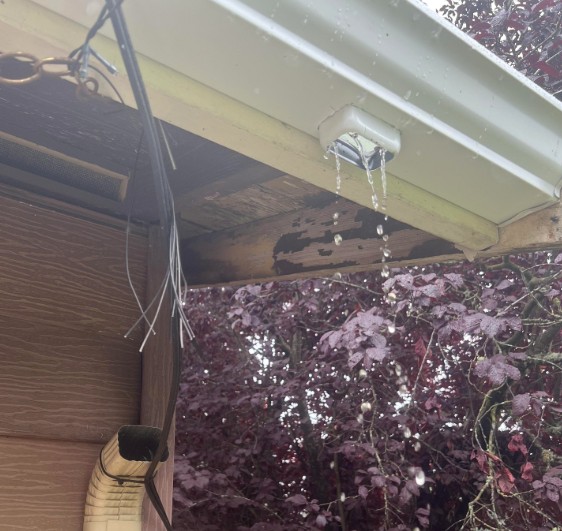
Open eave Failed soffit at a roof eave with the underside open, exposing water-stained sheathing and loose electrical wiring hanging below the gutter

The eave is open to the outside

Once the soffit is gone the eave cavity is exposed to weather, birds and wasps, and anything running through it — wiring included — is exposed with it. This is also the point where a soffit problem stops being cosmetic.

Storm damage repair
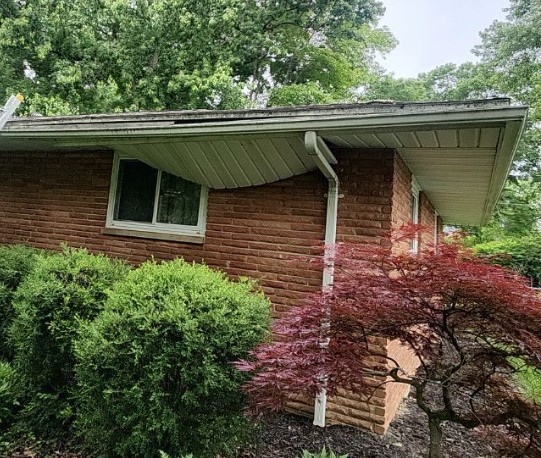
Sagging panel White soffit panel detached and hanging down from the eave of a brick ranch home in Beavercreek, Ohio

Panels dropping out of the channel

Soffit panels sit in a channel at each end. Wind lift, a swollen fascia board, or a channel that was never fastened properly lets them work free. Caught early this is a refasten; left alone the panel breaks and the eave opens up.

All roofline services
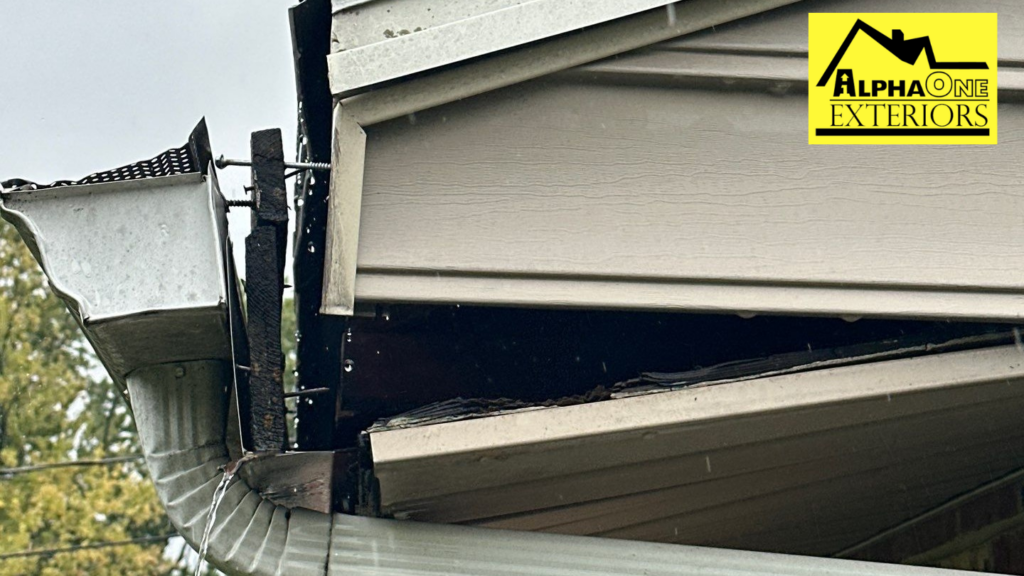
Trim separation Fascia and soffit trim separated at a roof corner where the gutter has pulled away, on a home in West Carrollton, Ohio

Trim pulling apart at a corner

When the fascia and soffit trim separate at a corner, the fastening behind them has usually let go first. The gutter tends to get the blame because it is the visible part, but the board it was fixed to is the thing that failed.

Gutter repair

The eave

What each part actually does

Four components, and only one of them is really trim. Select one to see what it does and what happens when it fails.

DRIP EDGE & FLASHING FASCIA BOARD SOFFIT PANEL SOFFIT VENTING

Repairable
Drip edge and flashing. A metal edge that directs water off the roof deck and into the gutter rather than behind it. When it is missing or badly lapped, water runs down the back of the fascia board where nobody ever looks — which is why the rot is usually well advanced by the time anything shows on the front.

Repairable
Fascia board. It closes off the rafter ends and it carries the gutter. It is also the first thing to rot, because it takes all the water the drip edge should have handled. Rotted fascia is the reason re-hung gutters pull loose again a season later — the fasteners are fine, the wood is not.

Repairable
Soffit panel. The underside of the eave. It keeps weather and wildlife out of the cavity between the rafter tails, and it sits in a channel at each end rather than being fixed across its face. When it sags or drops out, birds, wasps and squirrels get into the eave — usually before the homeowner notices the panel has moved.

Repairable
Soffit venting. This is the part almost nobody knows is structural. The perforations in the soffit are the intake for the whole attic ventilation system: air enters here, travels up the rafter bay, and exhausts at the ridge. Block the intake — with insulation pushed over the top plate, or with paint sealing the perforations — and the exhaust has nothing to pull. The attic stops ventilating even with a perfectly good ridge vent.

The part nobody checks

Why blocked soffit vents cause problems in the attic

Attic ventilation works as a pair: air enters low at the soffit and exhausts high at the ridge. Remove the intake and the exhaust has nothing to pull, so the system stops — even with a perfectly good ridge vent on the roof above it.

This is the failure that costs the most and shows the least. Nothing looks wrong from the kerb. The soffit is in place, the ridge vent is there, the roof is intact — and the attic is not ventilating at all.

What follows is a Dayton winter problem. A poorly ventilated attic runs warmer than the roof surface above it. Snow melts on the deck, runs down to the cold eave, and refreezes there. That is the mechanism behind ice dams, and it is why they come back every year in the same spot no matter how often the ice is cleared.

The same trapped moisture is what rots roof sheathing from underneath — slowly, invisibly, and from the side nobody inspects until the roof comes off.

Restoring the intake is not always a big job. Often it is clearing what is blocking it and putting proper vented panel back. But it has to be found first, and it is only found by looking.

Insulation over the top plate

Loose or batt insulation pushed out to the edge of the attic floor until it packs the vent channel solid. Common after an insulation top-up where nobody fitted baffles to hold the channel open.

Soffit painted shut

Perforated panel painted over often enough that the holes have closed. Each coat looks harmless. From the ground the soffit looks freshly maintained, which is exactly the problem.

The decision

Repair or replace?

Most roofline work is a repair. Here is roughly where that stops being true.

Repair

Usually enough when

  • One or two boards are affected
  • The rot is surface-level
  • Soffit panels are loose but sound
  • Fascia metal is loose but the board behind is dry
  • Venting is blocked but present
Replace

Usually better when

  • Rot runs along the whole run
  • A screwdriver goes into the board
  • Panels are brittle or broken
  • The board behind the metal has softened
  • There is no venting at all

Local conditions

Why the roofline fails first in Dayton

The eave is where a roof stops and a wall starts, and every junction is a place water can get in. It is also the coldest part of the roof in winter and the wettest in a storm. When a gutter overflows the water doesn't fall clear — it runs down the back of the fascia, which is the one surface nobody paints and nobody inspects.

Freeze-thaw
Ice dams
Wind-driven rain
Gutter overflow
Trapped attic moisture
Pest pressure

Process

Our roofline repair process

Ten steps. The first six are diagnosis, because the roofline is the part of a house where the damage and the cause are almost never in the same place.

01
Full roofline assessmentEvery elevation, not just the visible damage.
02
Probe the fascia for soft rot behind the metalFascia metal hides the board behind it completely. A wrapped fascia can look perfect from the ground while the wood underneath has gone entirely, and the only way to know is to probe it.
03
Check whether soffit venting is present and clearPresent, blocked, painted shut, or never installed — four different answers, four different jobs.
04
Check the drip edge and flashingMissing drip edge is the most common upstream cause of rotted fascia.
05
Identify the water sourceGutter overflow, missing drip edge, or ice. Replacing the board without finding this just resets the clock.
06
Give an honest read on repair versus replacementIncluding the runs where replacement is the cheaper answer.
07
Remove failed boards or panelsBack to sound material at each end.
08
Repair rafter tails or substrate where neededIf the rafter ends have gone, new fascia has nothing to fix to.
09
Install new fascia, soffit and ventingRestoring the intake path rather than simply closing the eave back up.
10
Reattach gutters and walk you through itRehung into sound wood, which is the whole point of doing it in this order.

The contractor

Why homeowners choose AlphaOne

01We probe behind the metalWrapped fascia looks fine right up until it doesn't. We check the board, not the capping.
02We restore venting, not just panelsClosing the eave back up without reopening the intake leaves the real problem in place.
03We find the water sourceNew fascia in the same conditions rots the same way. We look for what put the water there.
04Honest repair vs. replacementTwo boards is two boards. We are not going to quote a whole run for it.
05Warranty-backed workmanshipEvery repair is covered by the AlphaOne Advantage Warranty.
06Local since 2012We've served Dayton-area homeowners since 2012 and we plan to be here long after your project is finished.

Interest-free financing options are available on larger roofline work, and every repair is covered by the AlphaOne Advantage Warranty.

Soffit & Fascia Repair FAQs

Fascia is the vertical board that runs along the roof edge, closing off the rafter ends. It is what your gutters are fixed to. Soffit is the horizontal panel underneath, closing the gap between the fascia and the wall.

The practical difference is what they do. Fascia is structural — it carries the gutter. Soffit is the intake for your attic ventilation. Neither is decoration, though both usually get treated that way.

It depends how far the rot has gone and how much of the run it affects. One or two boards with surface-level rot can often be cut back to sound wood and pieced in. If a screwdriver pushes into the board with light pressure, that section is structurally gone and needs replacing.

The thing that decides it is usually the length of the run affected, not the depth. Rot along an entire elevation is a replacement job even if each individual spot looks minor.

Almost always because the fascia board behind them has softened. Gutter fasteners rely on sound wood to grip. Once the board has taken enough water to go soft, new fasteners hold for a season and then work loose in exactly the same way.

This is why we probe the fascia before quoting any gutter repair or gutter replacement. Rehanging into rotted wood is work you pay for twice.

Soffit panels are not fixed across their face — they sit in a channel at each end, which lets them expand and contract. Sagging means one of those ends has let go. Wind lift is the usual culprit, but a fascia board swelling with moisture will also push the channel out of alignment, and a channel that was never fastened properly will release on its own eventually.

Caught early it is a refasten. Left alone the panel flexes until it cracks, and then the eave is open.

If your attic relies on soffit-to-ridge ventilation — and most Dayton-area homes with a pitched roof do — then yes. The soffit is the intake. Air enters through the perforations, travels up the rafter bay, and exhausts at the ridge.

Not every soffit needs to be vented along its whole length, and some roof designs ventilate differently. But if there is a ridge vent up top and no working intake down below, the system is not doing anything.

You usually cannot tell from the ground, which is the problem. The two common causes are both hidden: insulation pushed out over the top plate until it packs the vent channel, and paint that has built up until the perforations have closed.

The signs tend to show up elsewhere — ice dams returning in the same spot every winter, an attic that feels hot and humid in summer, or frost on the underside of the roof deck. Checking properly means looking at the soffit up close and looking into the attic at the eave.

Sometimes. If the paint film is thin and the perforations are only partly closed, clearing them can restore useful airflow. More often the panel has been painted enough times that the holes are gone, and replacing that run with new vented panel is both cheaper and more reliable than trying to reopen hundreds of small holes.

We will tell you which case you are in rather than defaulting to replacement.

Yes, and it is one of the more common reasons people call us. A gap where a panel has dropped out of its channel is an open door into the eave cavity, and it is sheltered, dry and undisturbed — ideal for wasps, and for starlings and sparrows nesting.

We close the eave properly as part of the repair. We are not a pest control company, so if something is already nesting in there it needs removing first — sealing an occupied eave causes a worse problem than the one you started with.

A drip edge is a metal flashing at the roof edge that directs water off the deck and into the gutter rather than letting it run behind. It is a small, cheap component and its absence is one of the most common upstream causes of rotted fascia we find.

Without it, water tracks down the back face of the fascia board — the side nobody paints and nobody sees. By the time the front of the board shows anything, the damage has usually been running for years.

It depends on how much of the run is affected, whether the damage is soffit, fascia or both, how many storeys, the access, and whether rafter tails need repairing behind it. Restoring a couple of dropped soffit panels and replacing a rotted fascia run are very different jobs.

We are not going to publish a figure that will be wrong for your house. The free assessment ends with a written estimate for the actual work, and financing options are available on larger jobs.

Most soffit and fascia repairs are a one- or two-day job. Replacing the full roofline on an average single-family home usually runs to several days. What extends it is what we find behind the boards — rafter tails that need repairing, or sheathing that has been getting wet for long enough to matter.

We would rather tell you that at the assessment than discover it on day two, which is why step two of our process is probing rather than quoting.

Yes, and it is a legitimate finish — aluminium capping over sound fascia protects the wood and removes the repainting. The problem is when it gets used to cover up rot instead of fixing it.

Capping a soft board hides the damage and keeps the moisture in. It looks finished on the day and it fails quietly underneath. We cap fascia where the board is dry and sound, and we replace it first where it is not.

Not on its own, and we would rather say that plainly than sell you a fix that does not hold.

Restoring blocked intake venting addresses one contributing cause — an attic that cannot ventilate runs warmer than the roof above it, which is part of what drives the melt-and-refreeze cycle. So it genuinely helps, and on some houses it helps a lot.

But ice dams are usually a combination of three things: ventilation, insulation depth, and air sealing between the living space and the attic. If warm air is leaking up through ceiling penetrations, or the insulation is thin, opening the soffit vents will improve matters without solving them. Anyone who tells you new soffit alone guarantees no more ice dams is overselling it.
Yes. Soffit and fascia work is covered by the AlphaOne Advantage Warranty, which covers our workmanship. Coverage on the materials and their finish comes from the manufacturer and is separate. We set out which is which in writing rather than leaving you to work it out later.

The roofline is where it usually starts

A full roofline assessment, an honest read on repair versus replacement, and a clear written estimate either way.

Schedule Free Roofline Assessment

AlphaOne Exteriors · Dayton, Ohio · Since 2012

Soffit & fascia repair · Free estimate, no pressure
Schedule Free Roofline Assessment