

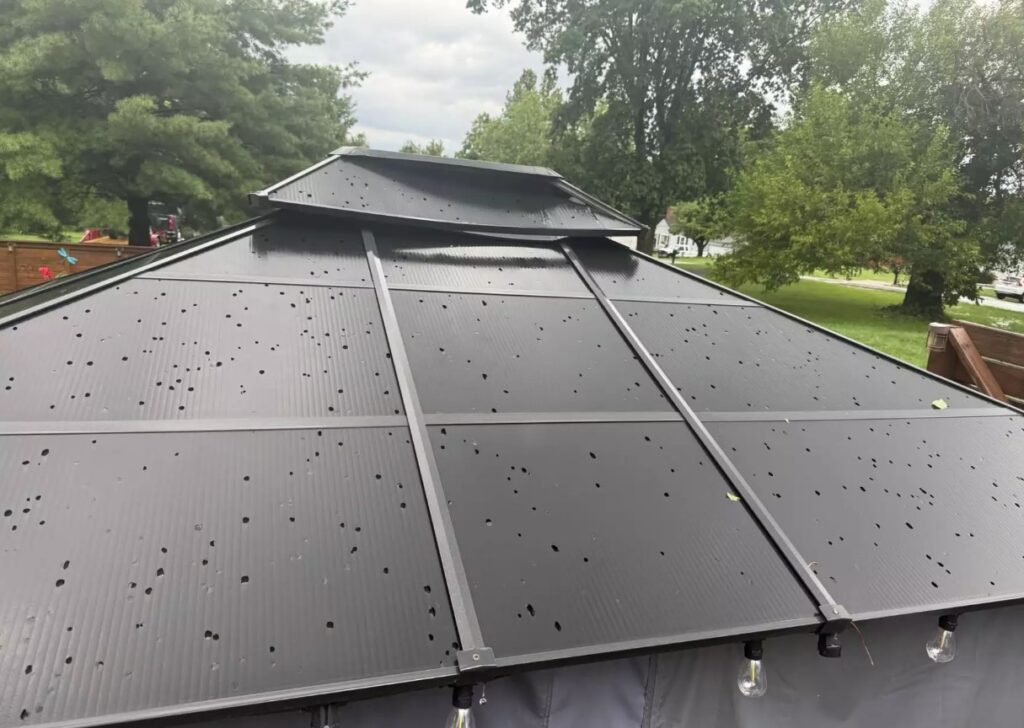
Miamisburg and surrounding parts of Southwest Ohio were hit by hail, strong winds, and heavy rain during severe thunderstorms on Friday, August 7, 2026. One-inch-diameter hail was reported a few miles east of Miamisburg around 2:45 p.m., while other areas in and around Miamisburg also experienced hail. WYSO documented hail damage to the metal roof of a gazebo near 11th Street in Miamisburg around 2:30 p.m.
For Miamisburg homeowners, that does not automatically mean every roof in the storm path was damaged. Hail damage can vary substantially from one house to another based on hail size, wind direction, roof slope, roofing material, roof age, tree cover, and the condition of the exterior before the storm.
However, if your home was in the affected area, this is a good time to inspect your roof, gutters, siding, window screens, exterior metal, and other exposed surfaces for signs of storm impact.
At AlphaOne Exteriors, we inspect and repair roofs and exterior systems throughout Miamisburg, Dayton, and Southwest Ohio. One thing our region teaches you quickly is that storm damage needs to be evaluated in context. The goal after a hailstorm should not be to assume the worst. It should be to determine what actually happened to your home and whether anything requires attention.
What Happened During the August 7, 2026 Miamisburg Hail Storm?
Severe thunderstorms moved through Southwest Ohio during the afternoon of August 7, bringing hail, heavy rainfall, and strong winds.
According to WYSO, hail damaged the metal roof of a gazebo near 11th Street in Miamisburg around 2:30 p.m. Approximately 15 minutes later, one-inch-diameter hail was reported a few miles east of Miamisburg. WYSO reported that other areas in and near Miamisburg were also pelted with hail, along with locations near Beavercreek.
The storm brought more than hail.
Montgomery County received more than an inch of rain in a relatively short period, resulting in standing water on some roads. Strong winds also brought down trees in or near Dayton, Xenia, West Carrollton, Kettering, and other communities across the region.
That combination matters to homeowners because a storm can affect several exterior systems at once.
A roof may receive hail impacts while wind stresses shingles and ridge caps. Gutters and downspouts may be dented. Siding or window screens may be struck by wind-driven hail. Heavy rain can then immediately test any area that was already vulnerable.
That is why a post-storm inspection should look at the entire exterior system, not only the roof shingles.
How Large Was the Hail Near Miamisburg?
One-inch-diameter hail was reported a few miles east of Miamisburg at approximately 2:45 p.m. on August 7, 2026. One inch is approximately the diameter of a quarter.
Hail was also reported elsewhere in and around Miamisburg, although hailstone size can vary considerably over short distances within the same thunderstorm.
It is important not to assume that a reported hail size automatically determines whether a particular roof was damaged.
Whether hail causes functional damage depends on several factors, including:
- Hailstone size, shape, density, and velocity
- Wind speed and direction
- Roof slope and orientation
- Roofing material
- Age and condition of the shingles
- Temperature at the time of impact
- Previous deterioration or installation issues
Two houses on the same Miamisburg street can therefore experience noticeably different results from the same storm.
Video: Hail Falling in Miamisburg on August 7, 2026
A Miamisburg resident captured this video of hail falling during the August 7 storm, providing a firsthand look at conditions experienced in the area.
Can 1-Inch Hail Damage an Asphalt Shingle Roof?
Yes, 1-inch hail can damage asphalt shingles under the right conditions, but the presence of 1-inch hail does not prove that a particular roof sustained functional damage.
This distinction is important.
Hail impacts can displace granules, bruise asphalt, damage the shingle mat, or create other localized impact marks. Older roofing materials may also react differently than newer shingles because years of UV exposure, temperature changes, moisture, and normal aging can make the material less resilient.
A proper hail damage roof inspection looks at the pattern of impacts across the roof rather than finding one questionable mark and immediately calling it hail damage.
We also look for collateral evidence on exposed components such as gutters, downspouts, roof vents, flashing, window screens, and other exterior surfaces.
Those clues help build a more complete picture of how the storm interacted with the property.
What Does Hail Damage Look Like on Asphalt Shingles?
Possible hail damage on asphalt shingles can include localized granule displacement, dark impact marks, bruising, exposed asphalt, fractures, or damage to the underlying shingle mat.
The challenge is that not every mark on a roof is caused by hail.
Normal granule loss, blistering, foot traffic, installation damage, tree contact, manufacturing characteristics, and ordinary aging can sometimes resemble storm damage.
Localized Granule Loss
Asphalt shingles are covered with protective mineral granules that help shield the asphalt from sunlight and weather.
A hail impact can loosen or remove those granules, leaving a darker spot where more of the asphalt underneath becomes visible.
Fresh hail-related granule displacement usually needs to be evaluated by its shape, location, pattern, surrounding conditions, and supporting evidence elsewhere on the property.
Widespread granule loss across an older roof is more likely to reflect normal aging than a recent hailstorm.
Bruising or Mat Damage
A sufficiently strong impact can compress or damage the layers beneath the shingle surface.
This type of damage may be more difficult to identify visually than obvious granule loss and generally requires close inspection.
The condition of the shingle before the storm matters significantly. Older, weathered materials may respond differently to an impact than newer shingles.
Cracks or Other Physical Damage
More substantial hail impacts can occasionally crack or fracture roofing materials.
If shingles are also lifted, displaced, creased, or missing after the storm, wind damage should be considered as another possible cause. The August 7 weather event included both hail and strong winds across Southwest Ohio.
Can a Roof Have Hail Damage Without Leaking?
Yes. A roof can experience hail-related damage without developing an immediate interior leak.
This is one of the most important things for homeowners to understand after a storm.
The primary job of an asphalt shingle system is to shed water. A localized impact can affect part of the shingle without immediately creating an open pathway through the entire roof assembly.
That means a dry ceiling the day after the storm is encouraging, but it does not by itself confirm that every exterior component is undamaged.
The opposite is also true: not every hail mark eventually becomes a leak.
That is why an inspection should determine whether observed damage is functional, cosmetic, or simply unrelated aging or deterioration.
What Should Miamisburg Homeowners Check After the Hail Storm?
Homeowners should safely inspect the roof from the ground and examine gutters, downspouts, siding, exterior metal, window screens, painted surfaces, and accessible interior areas for changes that appeared after the storm.
Do not climb onto a wet, steep, or potentially damaged roof yourself.
Check Gutters and Downspouts
Metal gutters and downspouts can provide useful evidence of hail exposure because dents can be easier to identify on these surfaces than on shingles.
Look for fresh dents, bent sections, separated joints, loose gutters, or other signs that gutter repair may be necessary.
Also look near downspout outlets for unusual concentrations of shingle granules. Granules alone do not prove hail damage, especially on an older roof, but a sudden increase after a storm can justify a closer look.
Look at Siding and Exterior Trim
Walk around all elevations of the home.
Vinyl siding may show cracks, punctures, splits, or impact marks. Aluminum materials may show dents. These are common signs that siding repair may need to be evaluated after a hailstorm. Painted trim can show fresh chips or other impact damage.
Pay particular attention to the sides of the house that appear to have received the strongest storm exposure.
Wind-driven hail does not necessarily strike every elevation equally.
Inspect Window Screens and Exposed Metal
Look for tears or impact marks in window screens.
Roof vents, flashing, fascia metal, gutter components, HVAC equipment, sheds, metal furniture, and other exposed materials can also provide useful evidence about the storm.
Collateral damage does not automatically prove that shingles are functionally damaged, but it helps establish how hail affected the property.
Look for Roofing Material Around the Property
Check the yard and perimeter for pieces of shingles, ridge caps, flashing, siding, fascia, or other exterior materials.
Remember that debris can come from neighboring homes during high winds, so finding a shingle in the yard is a reason to investigate—not automatic proof that it came from your roof.
Check Ceilings and Accessible Attic Areas
Inside the home, look for new water stains, damp insulation, discoloration, or moisture around roof penetrations.
An attic inspection can sometimes help identify leakage or moisture that has not yet reached a finished ceiling.
If you find active water intrusion, preventing additional interior damage and addressing the roof leak becomes the immediate priority.
Can Hail Damage Siding?
Yes. Hail can damage siding, although the type of damage depends heavily on the siding material, age, temperature, and force of impact.
Vinyl siding can crack, split, or develop holes when struck hard enough. Older siding may be more brittle than newer material.
Aluminum siding commonly shows dents.
Fiber cement is generally more impact resistant than lighter polymer siding, although sufficiently strong impacts can still chip or damage individual boards.
Pay special attention to siding edges, corners, windows, doors, and transitions where a crack can potentially affect water management behind the exterior.
Can Hail Damage Gutters and Gutter Guards?
Yes. Hail can dent gutters and downspouts and can damage certain gutter protection systems.
Although a dent does not automatically prevent a gutter from functioning, the entire system should be checked for alignment, hanger damage, separated seams, and drainage problems after a significant storm.
This is particularly important following a storm like August 7 because the hail was accompanied by heavy rainfall.
The next rain is often when a homeowner first notices that a gutter was shifted, loosened, or otherwise affected.
Can Hail Damage Exterior Paint and Trim?
Wind-driven hail can chip or damage painted exterior surfaces, particularly when coatings or substrates are already weathered.
Inspect fascia boards, painted siding, doors, window trim, and other exposed wood or painted materials.
Fresh chips that expose bare wood should eventually be properly repaired because a properly maintained exterior painting system is not merely decorative.
More Video From the August 7 Miamisburg Hailstorm
Another Miamisburg resident captured video during the August 7 storm, providing an additional firsthand look at the hail experienced in the area.
Should You File an Insurance Claim After the Miamisburg Hail Storm?
Do not assume that you need to file an insurance claim simply because hail fell in your neighborhood. First determine whether your property actually sustained damage.
That is the approach we recommend to homeowners.
Start by documenting visible changes and obtaining a professional inspection when there are reasonable signs of storm impact or uncertainty about the roof.
If damage is documented and you are considering a claim, review your own homeowners policy and speak with your insurance carrier about coverage, deductibles, reporting requirements, and applicable deadlines.
A contractor can document physical conditions and prepare repair or replacement estimates. The insurance carrier determines coverage under the terms of the policy.
Taking photos shortly after the event can also be valuable. Ohio homeowners should document damage and take reasonable steps to prevent additional damage following severe weather.
Local Hail Damage Inspections in Miamisburg, Ohio
AlphaOne Exteriors is a Dayton-area exterior remodeling company providing roofing and exterior services in Miamisburg, Ohio and communities throughout Southwest Ohio.
We inspect and work on roofing, siding, gutters, gutter protection, fascia, soffit, exterior painting, and other exterior components. That allows us to evaluate storm damage as a connected exterior system rather than looking only for damaged shingles.
Our goal after a storm is straightforward:
Determine what is actually damaged, document it clearly, explain what we find, and recommend repair or replacement only when the condition of the property supports it.
If your home was affected by the August 7, 2026 Miamisburg hailstorm and you would like a professional evaluation, contact AlphaOne Exteriors to schedule a hail damage roof inspection.