

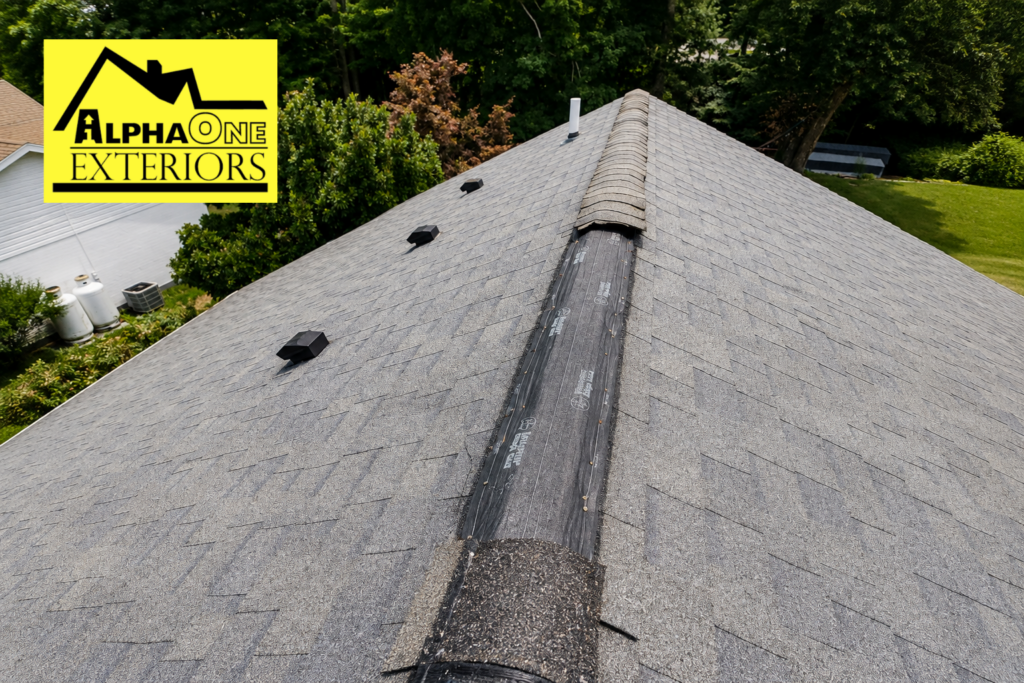
Walk around your home after a windstorm, and you may notice something lying in your yard that most homeowners don’t immediately recognize, a curved asphalt shingle with exposed nails or missing granules. In many cases, it’s a ridge cap shingle, and ridge cap shingles are usually the first part of a roof to fail in Ohio. If the rest of your roof looks fine, you might assume it isn’t a major concern, but early ridge cap failure is often one of the first warning signs of aging or storm damage.
At AlphaOne Exteriors, one of the most common patterns we see during roof inspections throughout Dayton, Beavercreek, Centerville, Kettering, Springboro, and surrounding Southwest Ohio communities is ridge cap shingles failing years before the rest of the roof. Homeowners are often surprised because the field shingles still appear to be in good condition.
This isn’t a coincidence.
Ridge cap shingles experience more wind, more sunlight, greater temperature swings, and more physical movement than any other part of an asphalt shingle roof. Ohio’s freeze-thaw cycles, severe thunderstorms, and seasonal weather extremes accelerate this process even further.
Understanding why ridge cap shingles fail can help you catch small problems before they become roof leaks, structural damage, or costly roof replacements.
What Are Ridge Cap Shingles?
Ridge cap shingles are specialized shingles installed along the highest point of your roof where two roof slopes meet. Their job is to seal and protect one of the most vulnerable areas of the entire roofing system.
Unlike the shingles covering the main roof surface, ridge cap shingles bend over the roof peak, creating a protective barrier that prevents wind-driven rain, snow, and debris from entering the roof system.
If your home has a ridge vent, the ridge cap shingles also help protect the ventilation opening while allowing hot, moist attic air to escape.
Although they make up only a small portion of your roof, they perform one of its most important jobs.
Ridge Cap Shingles vs. Field Shingles
Many homeowners assume every shingle on the roof is identical. In reality, ridge cap shingles serve a completely different purpose than the shingles covering the main roof surface.
| Ridge Cap Shingles | Field Shingles |
|---|---|
| Installed over the roof peak | Installed on flat roof slopes |
| Fully exposed on both sides | Protected by overlapping shingles |
| Experience the highest wind pressures | Experience lower wind forces |
| Constantly expand and contract at the roof ridge | Less structural movement |
| Usually the first roofing component to fail | Typically last longer |
Because ridge cap shingles sit at the highest point of the roof, they endure significantly harsher conditions than any other roofing component.
Why Ridge Cap Shingles Usually Fail Before the Rest of the Roof
The simple answer is that ridge cap shingles experience more stress than every other part of your roofing system.
During nearly every roof inspection we perform, the ridge line tells a story about how the roof has weathered over the years. Even when the main field shingles remain in relatively good condition, the ridge caps often show signs of aging first.
Several factors contribute to this.
1. They Receive the Strongest Wind Forces
Wind doesn’t strike every part of your roof equally.
As wind travels up the side of your home and over the roof peak, it creates powerful lifting forces along the ridge. Engineers refer to this as wind uplift.
Think about an airplane wing.
Air flowing over the wing creates lift. A similar principle occurs at the highest point of your roof during high winds.
Because ridge cap shingles sit directly in this high-pressure area, they experience significantly greater uplift forces than shingles lower on the roof.
That’s why after severe thunderstorms in Southwest Ohio, it’s common to find:
- Missing ridge cap shingles
- Lifted ridge caps
- Exposed nails
- Broken seal strips
…while the rest of the roof still appears intact.
2. They Experience Constant Expansion and Contraction
One factor many homeowners never consider is thermal movement.
Unlike field shingles that lie flat, ridge cap shingles are bent over the roof peak.
Every day they expand as temperatures rise and contract as temperatures cool.
Now multiply that movement by:
- hot summer afternoons
- cool evenings
- winter freezes
- spring warm-ups
Year after year.
Eventually, that constant flexing weakens the asphalt, adhesives, and fastening points.
One way to visualize it is to imagine bending a piece of cardboard in half over and over again.
The fold becomes the weakest point.
Ridge cap shingles experience that same type of repeated stress throughout their entire service life.
3. Ohio’s Freeze-Thaw Cycles Accelerate Aging
Southwest Ohio experiences dozens of freeze-thaw cycles every winter.
Moisture works its way into tiny cracks around aging ridge cap shingles.
When temperatures drop below freezing, that moisture expands.
As temperatures warm, it contracts again.
This repeated expansion gradually widens small cracks until they become visible failures.
It’s one of the primary reasons roofs in Ohio typically age differently than roofs in warmer climates.
4. They Receive More Sunlight Than Any Other Part of the Roof
The ridge is also exposed to sunlight longer than almost anywhere else on the roof.
Over time, ultraviolet rays slowly break down asphalt.
The shingles become:
- more brittle
- less flexible
- more likely to crack
- more likely to lose granules
Eventually the asphalt loses enough flexibility that even moderate wind events can crack or lift the ridge caps.
5. Installation Quality Matters More Than Most Homeowners Realize
One of the biggest surprises homeowners have after an inspection is learning that installation quality often determines how long ridge cap shingles last.
At AlphaOne Exteriors, we occasionally find roofs where the ridge cap shingles failed years earlier than expected, not because of the shingles themselves, but because of how they were installed.
Some of the most common installation issues include:
- Nails that are too short after installing a ridge vent
- Incorrect nail placement
- Improper overlap between ridge caps
- Ridge caps cut from standard three-tab shingles instead of manufactured ridge cap products
- Poor fastening during colder weather when shingles don’t seal properly
These issues may not cause immediate problems.
Instead, they slowly reduce the roof’s ability to withstand years of Ohio weather until one strong windstorm exposes the weakness.
Why Ohio Weather Is Especially Hard on Ridge Cap Shingles
Homeowners in Southwest Ohio face a unique combination of weather conditions that place tremendous stress on roofing materials throughout the year.
Unlike areas with relatively stable climates, Ohio roofs must survive nearly every type of weather imaginable.
Throughout a typical year, your ridge cap shingles may experience:
- Severe spring thunderstorms
- Straight-line wind events
- Hail
- Heavy summer heat
- High humidity
- Torrential rainfall
- Autumn temperature swings
- Snow accumulation
- Ice formation
- Repeated freeze-thaw cycles
Each season contributes a different type of stress.
Together, they create one of the most demanding environments for asphalt roofing systems.
This is one reason why regular roof inspections are so valuable. Small ridge cap issues that develop after one season often become much larger problems if they go unnoticed through another Ohio winter.
What We Commonly Find During Roof Inspections
After inspecting hundreds of roofs throughout the Dayton area, these are some of the most common ridge cap issues we encounter:
| Common Finding | Potential Concern |
|---|---|
| Missing ridge cap shingles | Wind damage or deteriorated fasteners |
| Cracked ridge caps | Aging asphalt or thermal movement |
| Exposed nail heads | Water intrusion risk |
| Granule loss | UV deterioration and aging |
| Curling ridge caps | Brittle shingles nearing the end of their service life |
| Loose ridge caps | Failed seal strips or improper installation |
| Improper nail placement | Increased likelihood of future wind damage |
Many of these issues can be repaired relatively inexpensively when caught early. Left unaddressed, however, they can allow moisture to reach the roof decking and eventually cause interior leaks.
Signs Your Ridge Cap Shingles Are Failing
Most ridge cap shingle problems start small and gradually worsen over time. Catching these warning signs early can often prevent roof leaks and more expensive repairs.
Many homeowners never notice ridge cap damage because it occurs at the highest point of the roof and isn’t visible from the ground. However, there are several signs you can safely look for during a visual inspection.
Missing Ridge Cap Shingles
One of the most obvious signs is a missing ridge cap shingle after a windstorm.
Unlike field shingles, ridge cap shingles are subjected to constant wind uplift. Once the seal between adjacent shingles begins to fail, a strong wind event may remove one or more ridge caps while leaving the rest of the roof relatively untouched.
If you find pieces of asphalt shingles in your yard after a storm, it’s worth having your roof inspected, even if everything appears normal from the ground.
Cracked or Split Ridge Caps
As asphalt ages, it gradually loses flexibility.
Years of sunlight, temperature changes, and thermal movement can cause ridge cap shingles to crack directly along the fold where they bend over the roof peak.
Small cracks may not immediately cause leaks, but they often allow moisture to penetrate deeper into the roofing system over time.
Curling or Lifting Shingles
Ridge caps should lay flat against the roof.
If you notice edges lifting or curling upward, the shingles may be drying out, becoming brittle, or losing their adhesive seal.
Lifted shingles are far more susceptible to wind damage during the next severe storm.
Granule Loss
The colored granules on asphalt shingles provide important protection against ultraviolet light.
As ridge cap shingles age, those granules gradually wear away.
Finding excessive granules in your gutters or downspouts, especially on an older roof, may indicate that your ridge caps and other roofing materials are approaching the end of their service life.
Exposed Nail Heads
Properly installed ridge cap shingles completely cover their fasteners.
If nail heads become visible, it often means the shingles have shifted, cracked, or blown partially loose.
Exposed fasteners can allow water to enter the roofing system and should be addressed promptly.
Common Ridge Cap Problems and What They Mean
| What You See | What It Could Mean |
|---|---|
| Missing ridge cap shingles | Wind damage or failed fasteners |
| Cracked ridge caps | Age, thermal movement, or brittle asphalt |
| Curling edges | UV deterioration and aging |
| Exposed nails | Increased risk of water intrusion |
| Granules in gutters | Protective surface wearing away |
| Uneven ridge line | Possible installation issue or structural movement |
Can Damaged Ridge Cap Shingles Cause Roof Leaks?
Yes. Damaged ridge cap shingles can absolutely cause roof leaks, although the leak may not appear directly beneath the damaged area.
Because ridge cap shingles protect the highest point of the roof, water entering through a damaged ridge can travel along the roof decking before eventually finding its way into your home.
This is why homeowners are often surprised when a ceiling stain appears several feet away from the actual source of the leak.
Over time, untreated ridge cap damage can contribute to:
- Roof deck deterioration
- Wet insulation
- Mold and mildew growth
- Interior ceiling stains
- Wood rot
- More extensive roofing repairs
Fortunately, ridge cap problems are often relatively inexpensive to repair when discovered early.
Does Ridge Cap Damage Mean You Need a New Roof?
Not necessarily. In many cases, ridge cap shingles can be repaired without replacing the entire roof. The right solution depends on the age and overall condition of the roofing system.
During every roof inspection, we evaluate the entire roof, not just the damaged ridge caps.
Repair vs. Replacement
| Situation | Repair | Replacement |
|---|---|---|
| One or two ridge caps damaged after a storm | ✓ | |
| Localized wind damage | ✓ | |
| Roof under 10–15 years old with good field shingles | ✓ | |
| Ridge caps brittle across the entire roof | ✓ | |
| Multiple areas of shingle deterioration | ✓ | |
| Roof nearing the end of its expected lifespan | ✓ | |
| Numerous previous repairs | ✓ |
A professional inspection helps determine whether the damage is isolated or simply the first visible sign that the roof as a whole is wearing out.
How to Extend the Life of Ridge Cap Shingles
Although no roofing material lasts forever, proper maintenance can significantly extend the life of your ridge cap shingles.
We recommend homeowners:
- Schedule a professional roof inspection every year.
- Have the roof inspected after significant wind or hail storms.
- Keep gutters free of debris.
- Trim overhanging tree limbs.
- Maintain proper attic ventilation.
- Address small roofing issues before they become larger repairs.
Many of the costly roof repairs we perform could have been avoided if small ridge cap issues had been corrected earlier.
What Happens If You Ignore Damaged Ridge Cap Shingles?
One missing or cracked ridge cap may not seem like a major problem.
Unfortunately, roofing damage rarely improves on its own.
Small issues often progress like this:
Damaged Ridge Cap
⬇
Water Penetrates Beneath the Roofing System
⬇
Roof Deck Begins Absorbing Moisture
⬇
Attic Moisture Increases
⬇
Interior Ceiling Stains Develop
⬇
Wood Rot or Mold Growth
⬇
Much More Expensive Repairs
This progression doesn’t happen overnight but once moisture begins entering the roof system, repair costs often increase dramatically.
Why Regular Roof Inspections Matter
At AlphaOne Exteriors, we’ve found that some of the easiest roof repairs are also the easiest for homeowners to miss.
Because ridge cap shingles sit at the highest point of the roof, deterioration often goes unnoticed until a storm blows shingles into the yard or water begins entering the home.
Annual roof inspections and inspections following severe weather allow small issues to be identified before they become larger structural problems.
If you live in Dayton, Kettering, Beavercreek, Centerville, Oakwood, Springboro, Xenia, Fairborn, or the surrounding Southwest Ohio communities, regular roof inspections can help maximize the lifespan of your roofing system while providing peace of mind.
Conclusion
Ridge cap shingles may cover only a small portion of your roof, but they protect one of its most important areas. Because they sit at the highest point of the roofing system, they endure the greatest exposure to wind, sunlight, freeze-thaw cycles, and seasonal temperature changes. It’s no surprise they’re often the first roofing component to show signs of wear.
Fortunately, early ridge cap failure doesn’t always mean you need a new roof. In many cases, timely repairs can restore the integrity of the roofing system and help prevent more costly damage.
If you’ve found shingles in your yard after a storm, noticed cracked or curling ridge caps, or simply haven’t had your roof inspected in several years, a professional evaluation can provide clarity before small issues become expensive repairs.
At AlphaOne Exteriors, we provide honest roof inspections and straightforward recommendations based on the actual condition of your roof. Whether your home needs a simple ridge cap repair or a complete roof replacement, our goal is to help you make an informed decision with confidence.
Frequently Asked Questions
Ridge cap shingles experience the greatest exposure to wind, sunlight, temperature changes, and thermal movement. Because they sit at the highest point of the roof, they naturally wear faster than field shingles.
Yes. Even a single missing ridge cap shingle can create an opening that allows water to enter the roofing system, especially during wind-driven rain.
Many ridge cap shingles begin showing signs of wear before the rest of the roof because of Ohio’s freeze-thaw cycles, strong winds, UV exposure, and seasonal weather extremes. Their actual lifespan depends on the quality of the materials, installation, ventilation, and overall roof maintenance.
If the damage is isolated and the rest of the roof is in good condition, repairs are often appropriate. If ridge cap deterioration is widespread or the roof is nearing the end of its service life, replacement may be the better long-term solution.
Most homeowners should have their roof professionally inspected once a year and after significant wind or hail storms. Regular inspections help identify ridge cap problems before they lead to leaks or structural damage.